Wellbeing Profile
Click to view full screen…
The Wellbeing Profile tab is your primary view of how children in your school or organisation are tracking across six core wellbeing domains:
Positive Identity — How children see themselves and relate to others
Connection to School — How children feel about school, their engagement in learning, and their learning environment
Behavioural Wellbeing — How children manage their own behaviour and make positive choices
Emotional Wellbeing — How children handle challenging emotions and maintain a positive outlook
Social Wellbeing — How children experience friendships and acceptance from peers
Positive Support — How children experience support at home and feel kept safe
To understand what each domain covers and how they're measured, see What Rumble's Quest Measures and Why.
Here's an overview of the Wellbeing Profile reporting group.
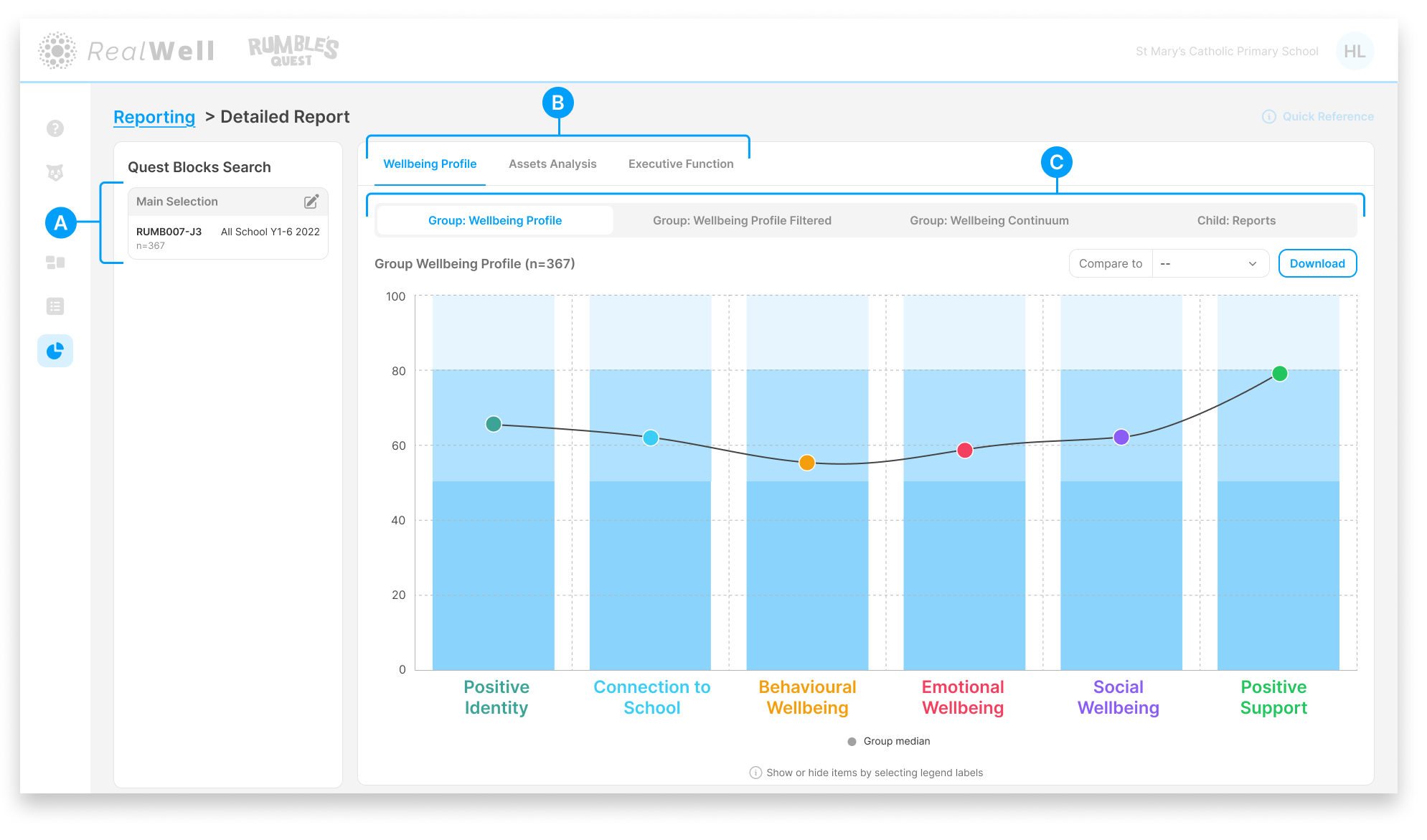
(A) Quest Blocks Search — Shows your selected Quest Block(s) and total sample size. Each Quest Block represents a data collection round, so you may have one or several selected depending on the period you're reporting on. Click the edit icon to adjust your selection.
(B) Reporting groups — Three reporting categories, each focusing on a different aspect of children's data. Wellbeing Profile is the active tab here.
Wellbeing Profile — The six wellbeing domains
Assets Analysis — The underlying assets within each domain
Executive Function — Cognitive skills
(C) Report tabs — Four reports, each offering a different lens on the data:
Group: Wellbeing Profile — Your group's wellbeing data across the six domains, with the option to compare against population benchmarks
Group: Wellbeing Profile Filtered — The same group data broken out by demographic categories
Group: Wellbeing Continuum — The distribution of children's scores across Strong, Coping, and Struggling bands
Child: Reports — Individual child scores and detailed reports
The first three are group reports, combining the data from all children in the selected Quest Block(s). The Child: Reports tab shifts to individual data.
Note: Group reports require 10 or more aligned responses to display. If your Quest Block has fewer than 10 responses, only the Child: Reports sub-tab will be available.
Group: Wellbeing Profile
Your group's median score for each of the six wellbeing domains, giving you a snapshot of overall group wellbeing at a glance. You can overlay benchmark data to see how your group compares against the broader Rumble's Quest population. School organisations can also compare against schools with a similar profile.
→ Read more: Group Wellbeing Profile
Group: Wellbeing Profile Filtered
The same group data as the Wellbeing Profile, broken down by demographic categories (Gender, Grade, First Nations Status), making it easy to spot patterns or differences across subgroups within your cohort.
→ Read more: Group Wellbeing Profile Filtered
Group: Wellbeing Continuum
Shows how children's scores are distributed across the Strong, Coping, and Struggling bands for each domain. This complements the median-based Group Wellbeing Profile by revealing the full spread of scores.
→ Read more: Group Wellbeing Continuum
Child: Reports
A table listing every child in the selected Quest Block(s) with their individual wellbeing scores across all six domains. Heat-mapped cells highlight areas that may need attention, and action icons let you drill into individual profiles:
Wellbeing Profile — The child's scores plotted across all six domains
Individual Responses — The child's answers to each question (non-school organisations only)
Domain and Asset Scores — The child's scores broken down by domain and underlying asset
→ Read more: Child Reports